
This week Avalon made created characters feel more like residents of a living world. NPCs can form visible relationships, speak with curated voices and persistent barks, carry authored behavior, and become independent shopkeepers, while Gold, storage, daily rewards, and deeper creator tools connect those characters back to play.
Build week: August 1 to 7, 2026. These notes cover Avalon's development and integration work this week. They do not announce a new public production game cook.
A Glimpse of Avalon's Intro
- Avalon's intro trailer is taking shape. This 22-second work-in-progress excerpt offers a glimpse of the worlds and characters waiting beyond the portal.
A 22-second excerpt from Avalon's work-in-progress intro trailer
NPCs That Remember, Speak, and Trade
- Creators can turn an NPC into a shopkeeper. The Forge can give an NPC authored stock, quantities, Gold prices, buyback rules, and rank-aware equipment drops. Each placed vendor owns independent stock, stays close to its post, and uses the same container presentation as storage. The end-to-end development implementation and automated contracts are complete; live-database and in-game trading still need final verification.
- Relationships now have visible consequences. Dialogue can show an NPC's relationship tier, affinity, and romance state, pulse when a relationship changes, and use that state in later responses. A bounded favor system can turn earned trust into small role-appropriate rewards without letting conversation outcomes bypass the authoritative reward path.
- NPCs found their voices. Forge exposes curated dialogue voices, newly created NPCs receive a voice, and persistent greeting, aggression, combat, and death barks can play as speech or audio. Saving an unchanged personality no longer regenerates its dialogue, and voice regeneration has an explicit Essentia cost.
- Authors have sharper behavior controls. NPC sight and hearing ranges, combat participation, non-combatant status, knockdown attacks, rank, scale, and vendor behavior now survive the authoring pipeline. Civilian templates no longer inherit a hostile default, and vendors do not wander away from the place a creator assigned them.
- Creator testing can step into a live NPC. A development-only Turn Into command can possess the NPC under the crosshair, use its body, stats, movement, and abilities, then return the creator safely to their own character and prior build context. This is creator and QA tooling, not a public player ability.
Gold, Progression, and Everyday Rewards
- Gold is now an authoritative character currency. Enemies can drop level- and rank-scaled Gold, nearby party members can share it, pickups provide clear feedback, and confirmed vendor sales update the live balance. Gold stays in inventory instead of occupying the always-on HUD.
- Daily rewards connect return play to the economy. The development services can grant daily Gold and 10 Essentia, expose the next reward state, and support both automatic login claims and a manual claim from Achievements when the automatic path needs recovery.
- Progression has more milestones and a better celebration. A 20-tier Spheres chain tracks playtime, sprint and spell actions can feed achievements, and level-up now arrives reliably with a HUD banner, VFX, light, camera, controller, and audio feedback. Early XP and Essence rewards were retuned around the new progression curve.
- Skill points behave like permanent progress. Spending a point no longer lowers the underlying primary attribute, one-star refunds can consume Astral Regret, and Skill Nebula preserves reflected star choices across relogs. The core also recenters correctly after the embedded view resizes.
- Quick-use items are clearer. The potion pouch is one labeled slot, players can choose the potion assigned to it, health potions restore more, and the Elderberry can grant a harvesting bonus through the same database-owned consumable action path.
Forge, Merlin, and Loom Learn New Tricks
- Player-authored abilities gained new building blocks. The Forge can compose bounded channel abilities, curated summons, execute phases, authored cast timing, knockback blending, and database-owned consumable effects. A dedicated capture harness now checks real casts, impacts, healing, and summons through a signed development session.
- Merlin can branch, sound, and go cinematic. Merlin gained fail-closed ELSE actions, a curated sound browser, toast and banner presentations, reliable selectors, fullscreen cinematic playback, Codex item conditions, and level ranges for spawned actors.
- Loom can build a broader creature roster. Quadruped generation and every supported Tripo rig type now travel through Loom, while unsupported future creature types are clearly marked as coming soon. Equipment art and generated armor, weapon, and model rows now flow back into Forge pickers instead of disappearing between tools.
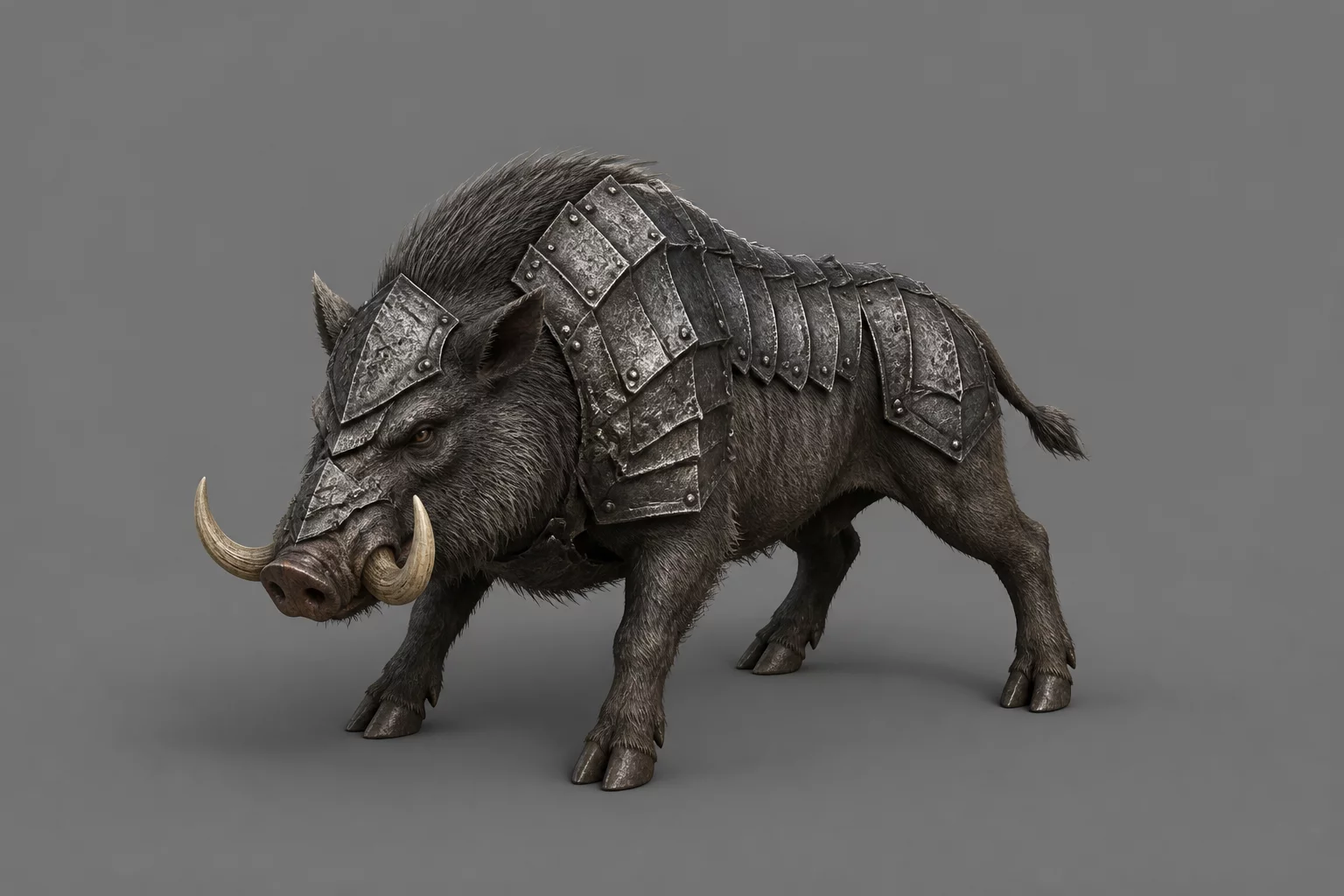
Armored boar concept for the development quadruped generation pipeline - NPC authoring is easier to reason about. Templates can be sorted and filtered by level, vendors have a dedicated section, the scale range now supports tiny and colossal characters with rank gates, and linked personality goals refresh immediately after a save.
- Quest guidance meets the player at the current keybind. Objectives can carry an optional action hint, and the HUD resolves the player's live bound key instead of embedding a stale prompt. Creator Workshop quests are available across eligible Editor worlds, including prefab-edit actions and sprint training.
Worlds That React
- Destructible building groundwork is now playable behind a development switch. Weapon sweeps can damage every block they cross, unsupported blocks fall, collapsing structures burst into budgeted material fragments, and walk-through props can still take weapon damage. Sean has played the player-driven destruction path; NPC structure-breaking still needs one behavior-tree content edit before it becomes a complete feature.
- Placed storage has an authoritative home. A 24-slot High Fantasy chest persists its contents by world and placed block, opens beside the player's bag, and uses server-owned transfers. Chests remain indestructible until item recovery exists, preventing a destroyed container from deleting inventory.
- Claim upgrades moved into the shared interface system. The new Claimstone screen shows all five tiers, exact benefits, live owned-versus-required materials, and authoritative validation while keeping the world visible. Party access, persistent claim markers, and preflight checks make claim management easier to understand.
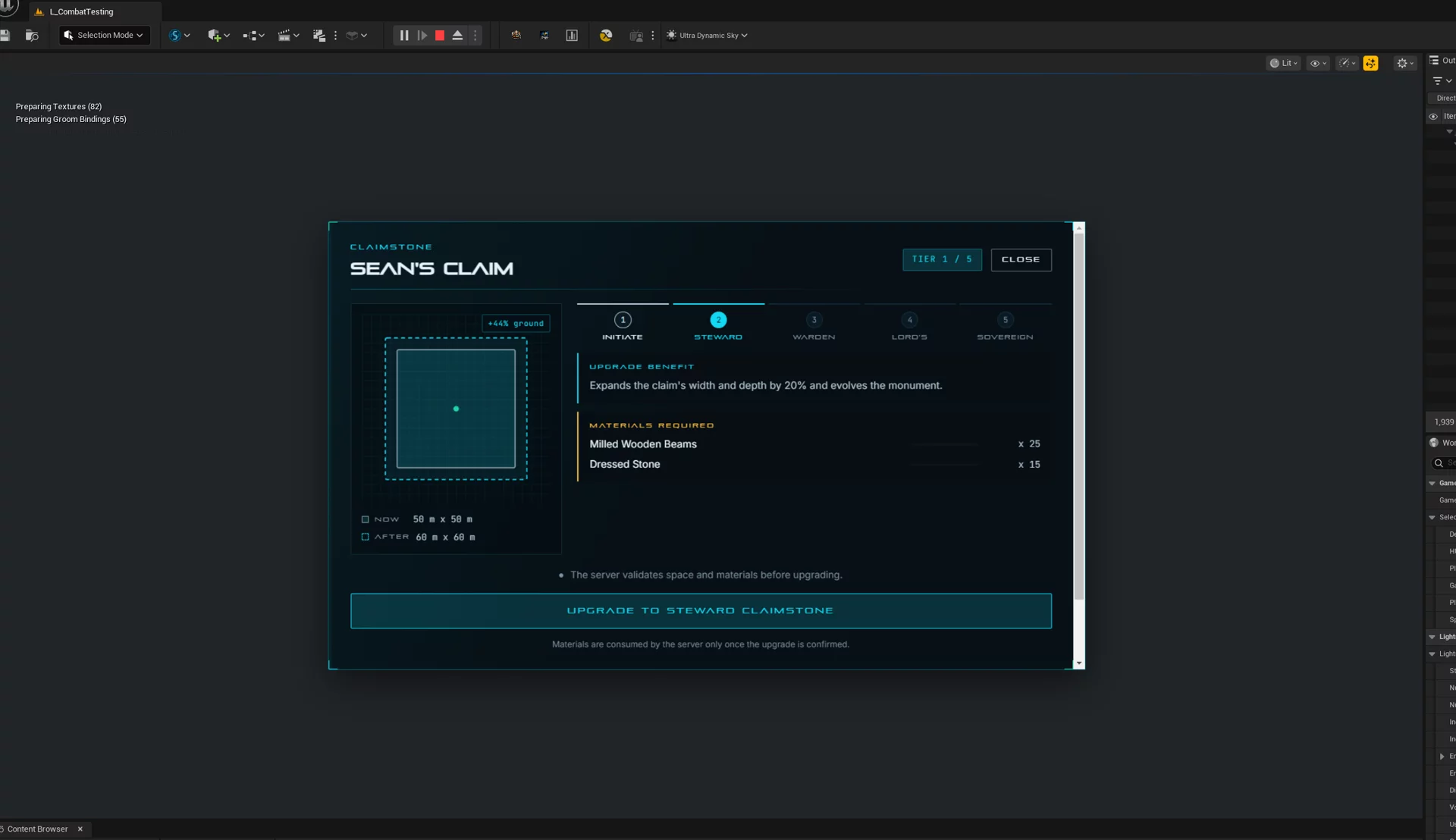
Claimstone upgrade interface running in the development editor - Harvesting responds to the tool and the terrain. Higher-quality axes and picks can increase yield, directed tree falls accelerate naturally, harvest actions grant server-owned XP, and wood, rock, and plant feedback now comes from the resource being struck. Additional fixes cover silent first swings, missing drops, moving interaction range, and ground nodes that showed a prompt but did nothing.
- World Core can protect authored zones. Development authoring now includes server-authoritative zone configuration and a matching editor surface, with bounded placement and custom-model budgets that fail closed when data is late or invalid.
A Smoother Player Experience
- Character selection presents the whole hero. Authored full-body stage art covers the lineage variants, Drakon sub-lineages persist with their intended color, duplicate preview bodies are suppressed, and the roster now sorts and defaults by last played after a relog.
- Social state recovers instead of going stale. The Party tab lists real members and refreshes after membership events, in-world party frames can resolve connected allies, first-contact DMs arrive, and a dropped event channel rejoins before invitations, party changes, and incoming chat disappear for the session.
- Embedded interfaces feel less embedded. Mouse-wheel scrolling now moves at a native browser rate, achievement claims preserve scroll position, tooltips avoid the native character doll, Codex placement returns to mouselook, and returning from an alt-tab no longer leaves the player locked behind stale UI-only input.
- Maps remember exploration. Fog reveal covers more useful ground, explored areas persist per character and level, full-map labels read horizontally, and icon hover text explains destinations without cluttering the minimap.
- Combat information keeps up with the fight. Boss encounters gained a real encounter bar, enemies show poise and stagger feedback, telegraphed attacks no longer deal early damage, knockdown recovery is less prone to correction replays, and nameplate levels update when a character levels up.
Under the Hood
- Crash diagnosis starts with the matching symbols. Shipping builds retain useful logs, the symbol tool can resolve game- and worker-thread crashes from the exact staged executable and PDB, and fixes landed for inventory startup, render-target lifetime, invalid placements, CommonUI focus, fog textures, groom streaming, and recoverable frame-generation errors.
- Fullscreen tools stop paying for hidden work. Skill Nebula can suppress the unseen 3D world while its opaque canvas is open, and off-screen generated NPCs return to visibility-based animation ticking after a short grace period.
- Development and production routes are harder to cross. Game, inventory, social, Marketplace, crash, editor, and membership traffic now follow the authenticated stream and exact service placement. Release gates also catch schema, dependency, migration, and stale-build drift earlier.
- The launcher closes two frustrating loops. Patch Notes navigation is repaired at the source, and an installed game can be removed from the Tools screen without manually finding its files.
- Build status: focused game, server, frontend, launcher, service, and migration checks passed for the cited changes, with individual limitations called out above. A new public production game cook was not verified for these notes, and vendor trading, destructible-world defaults, and the latest production Edit flow still need their stated runtime checks.