
This week Avalon turned creation into progression. A ten-quest Creator Workshop now teaches builders through the same authoritative events used by Quest Forge and achievements, while a rebuilt HUD makes combat, objectives, cooldowns, and progression easier to read.
Build week: July 24 to 31, 2026. These notes cover Avalon's development and integration work this week. They do not announce a new public production game cook.
Creator Workshop, Quests, and Creator Rewards
- Creator onboarding became a real quest line. The development catalog now includes ten linked, account-scoped Creator Workshop quests authored by Avalon System. The journey teaches building through real actions, including entering Build Mode, placing a verified house, working with Codex content, and completing creator objectives.
- Quest Forge can listen for what builders actually do. Creators can author objectives around building, deleting, crafting, creating and editing prefabs, placing exact blocks, NPCs, items, and props, and upgrading structures. Those objectives use the same server-authoritative event stream as achievements and The Forge.
- Quest lines are easier to extend and install. Authors can chain onto quests already installed in the current world, perform whole-line operations without leaving half-updated chains, and choose account or character progress. The newest Codex frontend also supports All, Editor only, and Play only installation modes for eligible account-progress quests.
- Creation can earn Essence. The integrated development service catalog now contains 22 account-wide creator achievements across building, Codex placement, Loom, and Marketplace activity. Rewards range from 50 to 500 Essence, and new accounts are queued for 300 starting Essence. Production rollout still needs verification.
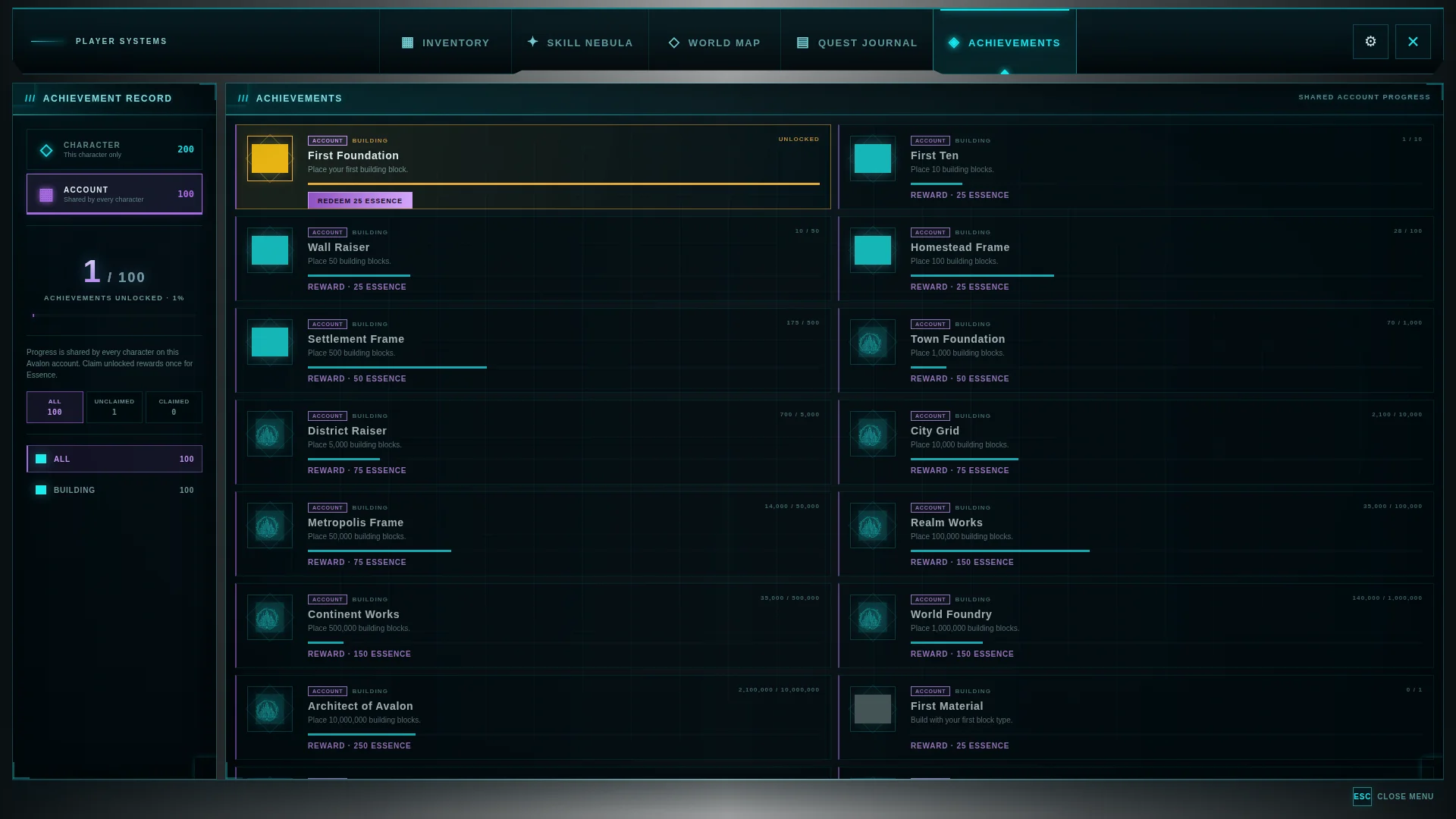
Account achievement review with development fixture data shown
A Clearer HUD and Sharper Combat
- The HUD speaks one visual language. Player and party frames, chat, quest objectives, the ability loadout, quick items, and the experience rail now share one translucent nerve-link presentation. Gold is reserved for primary information, while cyan and mint keep secondary status readable.
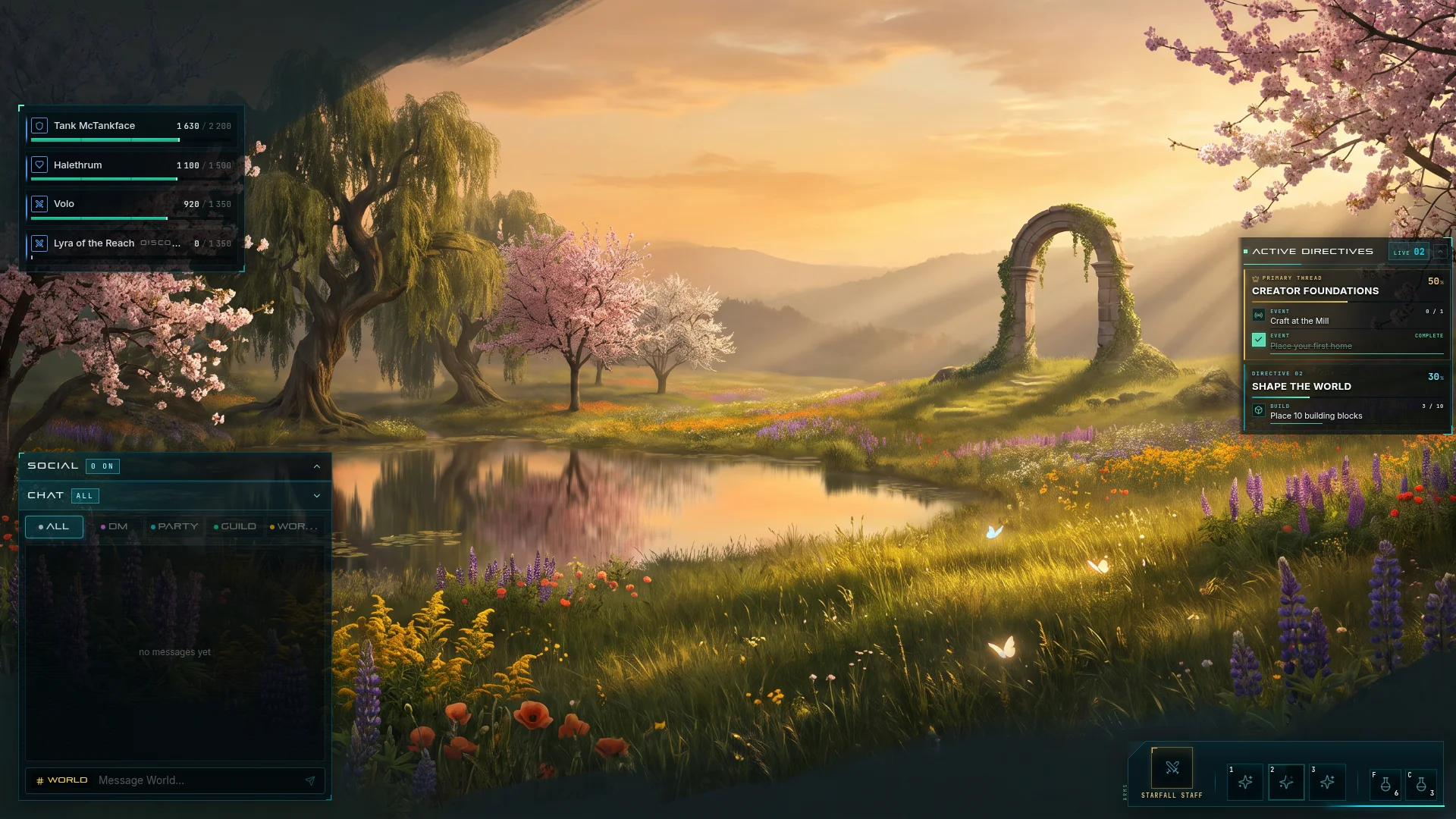
HUD presentation preview using development fixture data over approved Elysmalla key art - Your action bar is easier to read under pressure. The bottom-right loadout shows the active weapon, numbered abilities, radial cooldown sweeps, and F and C quick items. A Combat HUD Fade setting quiets nonessential panels while keeping XP visible and letting quest progress briefly reappear.
- Hits carry more weight. Confirmed attacks can add a restrained camera punch, radial motion blur, a glitch flash on the victim, clearer damage numbers, and a focus reticle tied to the shared target selector. Projectile headshots are now decided authoritatively, including a fallback for custom models.
- Movement and impact effects meet the terrain. Weapon strikes on landscapes, jump takeoffs, hard landings, knockdowns, tree chops, rock hits, and large-creature footfalls now have dedicated dust and impact treatment in the development build.
- Two attack lockouts were repaired. Weapon state now catches up when equip data races component startup after a relog, and client and server weapon-slot decisions use the same lockout window. Focused builds and tests passed; the reported divergence has not yet been reproduced end to end in PIE.
Crafting, Harvesting, and Building
- Crafting has a deeper progression spine. The High Fantasy catalog now carries 183 categorized recipes, Raw Hide and Refined Stone chains, station-specific tiers and upgrade costs, exact multi-output grants, and Claimstone upgrade recipes.
- The Mill and Kiln have authored homes. Both stations now live in the High Fantasy kit instead of relying on runtime injection. Station previews use their CDN models at a 3x default scale, and the Mill connects to 15 existing recipes. Automated checks passed; manual placement, crafting, and reload verification is still pending.
- More resources have real sources. Species-specific logs were assigned across 110 tree nodes, Copper, Tin, Titanium, and Starfall became mineable in Elysara, missing crafting materials gained loot sources, and bounded Grove and Quarry sites reuse the authoritative harvest loop.
- Harvesting communicates each stage. Trees now chip, fall, and hit the ground with separate feedback; rocks use stone-specific impacts; bushes no longer vanish between frames; and duplicate tree instances are removed together instead of leaving an unchoppable twin.
- Building preserves creator intent more reliably. Prop-bearing prefabs can be saved and placed, volume selection respects its bounds, duplicated scaled props keep their size, decorative Dungeon Kit objects can scale, and prefabs can retain standalone Merlin members.
Forge, Loom, Codex, and Skill Nebula
- Narrative fields can help with the first draft. Enhance Text is integrated for NPC descriptions, personality descriptions and motivations, and lore facts. It uses neighboring fields as context, preserves the author's original text on failure, and offers Undo after a successful rewrite.
- Loom keeps the important choices in view. The generation prompt now sits directly below the model name, the asset-type picker is one row, Generate stays visible beneath the form, prop scale is compact, and every job shows its Essence cost.
- Upload Image was moved out of the game process. Loom and the bug reporter now launch a hidden helper for file selection, avoiding the shell-extension crash path and a detached-process bug that made the button appear dead. Builds and launcher-level tests passed; an in-game click-through is still pending.
- Forge and Codex recover from stale or missing data. Forge now surfaces save failures, browses lore by source, loads authoritative loot tables, and shows Loom-generated NPC models. Codex republishes NPC, prop, item, and kit data whenever it opens, so a dropped one-time update no longer strands newly acquired content.
- Skill Nebula now trusts the live catalog. The selected star layout in Skill Nebula persists per character, every attribute has one starting point, generic stars advertise the +1 they actually buy, placeholder names cannot leak onto unused stars, and the embedded hard-coded skill list is gone.
Player Experience and Reliability
- The launcher appears immediately. A boot splash replaces the blank startup window, a second launch raises the existing instance, missing UI assets produce a readable error, and the rebuilt interface gives Install, Play, channel selection, sign-in, and patch notes clear labels.
- Large inventories can reach the client. Persistent inventory replication is now batched below Unreal's bunch limit and prioritizes equipment and consumables. The related network ceiling was raised for both send and receive paths. This requires a matching client cook and server deployment.
- Character presentation recovers more cleanly. Partial appearances fill missing body and head pieces from lineage defaults, Gatoi and Myrkoi stay distinguishable on the roster, and a stalled roster request no longer looks like deleted character data.
- Nameplates respect nearby geometry. Three visibility samples span each overhead plate, and the plate fades in proportion to how much of its width is blocked. Text stays crisp without painting through the wall around a doorway.
- World and loading interruptions are less costly. The New World retry path resumes the world it already created instead of duplicating it, blank forks receive a usable world slug, long teleports keep the current world's artwork stable, and the map-load screen no longer covers that artwork with an opaque panel.
Under the Hood
- Networked gameplay now has a real test lane. The PIE harness runs a dedicated server and connected client with a possessed Avalon character, then validates movement, prediction, damage, death, checkpointing, health, and the authoritative gameplay-event bus through production input paths.
- Bug reports can carry the next verification cycle. QA can fail a report from inside the game with a fresh note and log iteration, while the internal Cyphe queue can claim a report, attach implementation evidence, and return it to QA.
- Build V2 remains bounded groundwork. A server-approved, Classic-by-default selector, a read-only High Fantasy catalog, and a dormant progression projection now exist behind fail-closed gates. Classic building remains the active path.
- Release checks got stricter. Migration bytes are protected from line-ending conversion, staged cooks verify appearance-critical assets, and game analytics are rolled up in bounded batches instead of sending one request per event.
- Build status: targeted game, server, frontend, launcher, and service checks passed for the cited changes. No new public production game cook was verified, and the Mill, file-picker, large-inventory, and attack-recovery paths still need their stated runtime or deployment checks.